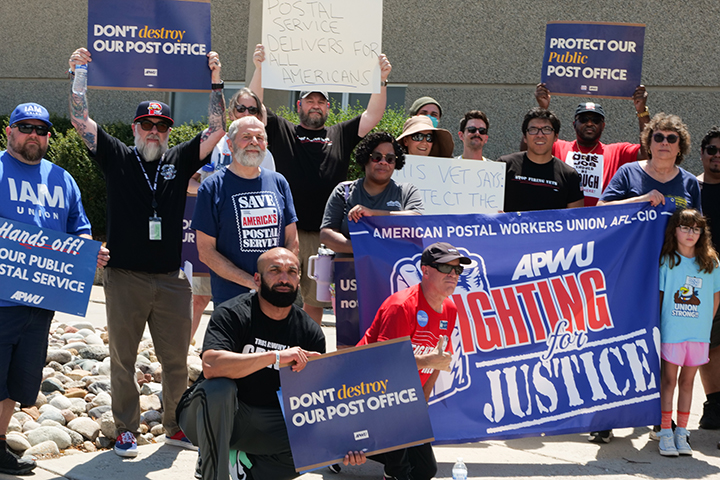
Metro postal workers protest potential threats they say Trump poses to mail delivery, voting
AURORA | The U.S. Postal Service is emerging as a pivotal player in the midterm elections.
Postal workers in and near Aurora are making clear they’re energized to move into the public spotlight.
“People depend on the Post Office, and they like it,” Denver area postal worker Steve Brown told the Sentinel last week during the National Day of Action to Protect our Post Offices. Brown and others turned out to the Denver main postal service headquarters in northeast Denver for a local protest. “We want the public to become more aware of some of the threats we’re facing.”
Brown, a retired postal union worker, said that David Steiner, the Trump-appointed postmaster general, has “slowed down the mail.”
“Mail from Denver to Denver used to be overnight, from Denver to New York City used to be three days, and now going to the coast could be up to seven days,” Brown said.
Union members say Trump and his administration have pushed a false narrative to discredit vote-by-mail systems.
APWU National posted on social media that: “APWU members in Denver stood together during our National Day of Action to protect our public Postal Service. We’re fighting for a strong, universal USPS that serves every community, no matter how rural.”
Besides regular postal operations, President Donald Trump is seeking greater control over mail balloting while a change to how the agency processes mail is leading to criticism that it’s failing to deliver ballots on time.
Democratic officials have raised concerns over the past few weeks about how quickly the Postal Service will process ballots after tens of thousands of them in California and hundreds in Wisconsin arrived at local election offices too late to be counted in elections earlier this year.
A legal fight over Trump’s executive order on mail balloting is now before the U.S. Supreme Court.
Roughly five weeks before the first midterm ballots are mailed out, the U.S. Postal Service is emerging as a pivotal player in an election season that will determine control of Congress.
President Donald Trump is seeking greater control over mail balloting through an executive order while a change to how the agency processes mail is leading to criticism that it’s failing to deliver ballots on time.
At the same time, Trump is leveraging his political clout to push his SAVE Act through Congress, despite resistance even from some Republicans.
Democratic officials raised concerns two weeks ago about how quickly the Postal Service will process ballots after tens of thousands of them in California and hundreds in Wisconsin arrived at local election offices too late to be counted in elections earlier this year.
Top election offices in Kansas and Michigan are urging voters who want to cast their ballots early to avoid the mail and instead drop them off in person.
The Postal Service replied to those concerns by saying it remains “committed to fulfilling our role in the electoral process.”
“We provide a secure, efficient, and effective way for citizens to participate when policymakers decide to use mail as part of their elections,” it said in a statement last week.
Trump’s order puts more focus on mail ballots
The Postal Service faced similar questions about mail delivery in 2024, but the scrutiny this year is heightened because of an executive order Trump issued in March that seeks to create a national voter list to guide the Postal Service in deciding who gets a mail ballot.
The order has sparked multiple lawsuits and federal court orders, leading to a case now before the U.S. Supreme Court in which the administration is asking the justices to allow it to impose its restrictions on mail balloting.
Trump has lied for years about voter fraud to try to explain away his loss to Democrat Joe Biden in 2020, and mail balloting is a favorite target, even though he has used the method himself. During a recent stop in Michigan, he falsely characterized mail balloting as “inherently corrupt” and added, “Hopefully there will be no mail-in ballots.”
A 2025 report from the research group Brookings identified about four cases of fraud for every 10 million mail ballots cast.
Despite Trump’s attacks, the method remains popular with voters of both major parties. In 2024, nearly 30% of U.S. voters cast their ballots by mail, according to federal data. In Michigan, where competitive U.S. House and Senate races could help determine the balance of power in Congress, the state said it has sent out more than 2 million absentee ballots for the state’s Aug. 4 primary.
Colorado, with some of the highest voter turnout rates in the country, has provided mail-ballot elections since 2014.
Colorado Secretary of State Jena Griswold, Gov. Jared Polis and Attorney General Phil Weiser have recently stood up for the accuracy and soundness of the state’s mail-ballot election system and rebuked Trump’s allegations and current plans.
“Trump will not be able to use the Postal Service to control which voters receive a mail ballot, and cannot use the DOJ to intimidate election officials into following his unlawful order,” Griswold said in a statement in June. “The Constitution is clear: States run elections, not Trump.”
Postal officials agree.
“We want to keep vote by mail. We want to protect it. We want to expand it,” said Jonathan Smith, president of the 200,000-member American Postal Workers Union, which launched a campaign in April promoting it and is opposed to turning the Postal Service into an election administrator. “Why? Because it works.”
Legal battles intensify over Trump’s order
The Postal Service proposed a rule in June in line with Trump’s executive order that would create a national list of eligible voters, based on databases kept by other federal agencies. Only those on the list would be eligible to receive mail ballots.
Democratic officials in nearly two dozen states filed a federal lawsuit in Massachusetts. A federal judge there blocked Trump’s order last month, and an appeals court upheld that ruling, prompting Trump’s appeal to the Supreme Court. But the appeals court for the District of Columbia refused Tuesday to block the order in a separate case, calling a legal challenge premature.
Democratic senators and governors have written to the Postal Service urging it to abandon efforts to implement Trump’s order.
“Donald Trump has shown he’ll stop at nothing to meddle in our upcoming elections,” Wisconsin Sen. Tammy Baldwin said in a statement to The Associated Press. “At best, this new push will exacerbate already severe delays for mail-in voters and at worst, it will stop eligible Americans from casting their ballots.”
In a letter to Democratic senators earlier this month, the heads of the Postal Service said they were abiding by the court rulings that had halted the executive order. But Smith, of the postal workers union, told the AP on Tuesday that USPS information technology staffers who are union members are working on a planned portal for the list of eligible voters “behind the scenes.”
The Postal Service declined to respond to Smith’s statements and said it could not comment about whether it’s moving forward with work related to Trump’s order because of the litigation.
The postal workers’ union opposes the plan for a portal, a national list of eligible voters and using that list to determine who can receive a mail ballot. Smith said it shouldn’t be postal workers’ responsibility “to decide who can vote and who can’t vote.”
A plan to consolidate mail processing centers upsets officials
The Postal Service has been under financial stress for years and has been consolidating mail processing into fewer regional centers. Mail travels an average of 139 miles to reach one and sometimes 500 miles, according to a recent Brookings report.
In January, a group of mostly Democratic senators said it was concerned about a decision to end twice-daily mail dispatches from local post offices to regional processing centers. The result is that mail arriving after the only daily dispatch would go out the next day.
California officials said the change was a factor in the state rejecting more than 148,000 ballots from its June primary, with 63% of them arriving too late despite a seven-day grace period. Officials worried that some ballots were postmarked at processing facilities the day after they were dropped off at a post office, possibly invalidating them. Wisconsin officials also said hundreds of ballots from an election in April arrived late.
The Postal Service said postmarks generally are being applied with automated equipment at processing centers, “in the same manner and to the same extent as before.” It said someone who wants to make sure their ballot envelope gets a timely postmark can get a free one applied by a postal worker.
A report on the 2024 election by the USPS Office of Inspector General said the Postal Service handled more than 59 million pieces of ballot mail from Sept. 1 to Nov. 15 that year and that 97.3% arrived on time.
At least one Colorado legislator said she’s behind ensuring mail-balloting continues in Colorado and that the USPS continue its part. She thanked local union members for “stepping up to the plan and doing what needs to be done.”
Trump “will chip away and chip away, and now they don’t want mail in our ballots,” Littleton Democratic state Rep. Sheila Leider said at the Denver protest last week. “We cannot allow them to destroy our democracy.”
Read more At creative reuse centers, old art supplies get a new life at a fraction of the cost
Read more What to Stream: ‘Ted Lasso,’ Billie Eilish, Stray Kids, ‘You Me & Tuscany’ and ‘The Shards’
Read more ‘Sopranos’ actor Vincent Pastore, known for playing mobsters and tough guys, dead at 80
