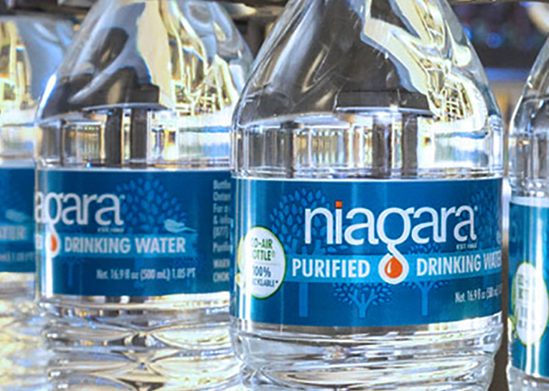
Aurora considers penalties for Niagara Bottling over drought water use
AURORA | City officials are contemplating consequences for its largest water consumer, Niagara Bottling, which has not yet reduced its consumption despite drought restrictions imposed citywide requiring a 20% reduction in use.
While the bottling plant has not yet violated the drought restrictions, the facility is on track to use more water than its annual allocation unless consumption slows down, according to Shonnie Cline, director of internal and external affairs for Aurora Water.
Aurora Water officials met with the city council in a closed meeting on Monday to discuss next steps.
Cline said the city is working with Niagara to address the issue, but she couldn’t provide many details because the conversation took place in a council executive session, which is closed to the public. Cline said time is of the essence to address the water use.
“The overall goal was just to get them to reduce their usage under our really significant drought issues,” Cline said of the meeting. “The simple fact of the matter is that they have not gone over that reduced allocation, but they also haven’t changed the way that they’ve done production. So their production has continued on like it’s a normal year.”
9News reports that Niagara is allocated by the city’s water department 178 million gallons per year, but Cline said the plant typically uses more than the allocation and last year used about 200 million gallons of water. Cline said she alerted Niagara in April that its annual allocation would have to be reduced because of drought conditions.
A spokesperson for Niagara Bottling said in a statement that the company shares the goal of water conservation and has already installed an in-plant recovery system that’s expected to save approximately 8 million-10 million gallons of water in 2026 and about 20 million gallons annually thereafter.
“We understand that every responsible member of the community has a role to play when water supplies are under pressure and Niagara is willing to do its part to reduce water consumption during drought conditions,” the statement says.
The company says it will continue to work with Aurora Water to reduce its consumption, including through “turf replacement and other permanent water-efficiency initiatives.” It expects the combined efforts will cut use by 60 million gallons in 2027.
The philanthropic arm of the company also works with Colorado Water Trust to restore water to the Colorado River, according to the statement.
If Niagara does use more water than it has been allocated, then the city may impose consequences, so far undefined.
“We’re kind of in uncharted territory here,” Cline said. “We’ve never been in a position where we’ve had to ask a company like Niagara to cut back.”
Cline said company leadership is actively engaged in conversations about adjusting water usage, but noted that reducing water consumption is a more complex request for a business with a set production schedule.
“They have certainly been trying to identify solutions,” Cline said. “They told us that they set their production schedule in October of the previous year. Obviously, in October of the previous year, we didn’t know what was going to happen over the winter, so we couldn’t give them the heads up.”
For large commercial and industrial water users, the required reduction is calculated from the annual allocation, not from the previous year’s water use. Restrictions for non-recoverable water users do not dictate exactly when or how those reductions must occur.
In May, city council members imposed restrictions on residents that called for immediate reductions of water use.
In non-drought years, there’s no penalty for businesses like Niagara using more than their allocation, the user just pays for the extra water. However, in drought conditions, going over the allocation is much more serious and can cause trickle-down effects because the system is not able to naturally replenish its storage.
“It’s not that we’re targeting Niagara — it’s just that we have got to do what we can to ensure that we keep as much water in our reservoirs, in the event that we do not end up with the snowfall that we need over the winter,” Cline said.
Cline said the extreme heat of this year is leading to more water lost to evaporation, adding that rain is only helpful if it occurs where it can be captured, like over a reservoir.
Currently, the Aurora Reservoir is at 51% storage, which is significantly lower than the typical rate this time of year of about 80%.
“We expect it to take us every bit of three to five years to recover our storage, and that’s if we have continually good winters,” Cline said.
So far, Aurora Water says the city is reducing its water use, though it hasn’t met the 20% goal reduction for annual use citywide. Overall water usage, including indoor use, is down 8%, while outdoor irrigation is down 20%.
So far this year, Aurora Water has issued 2,429 overuse warnings, but it has issued only 201 violations totaling $73,625 in fines, according to Kirby Shedlowski, manager of public relations. No residential accounts have gotten a third violation, which comes with a larger fine. For persistent violations, the city can shut off a property’s water.
Cline said the city’s aggressive enforcement of drought restrictions and its advanced metering infrastructure have helped the city keep a handle on water usage. However, Cline said the situation is extremely dire, and she worries that the economic impacts could expand if the drought worsens.
“(Stage 2 drought restrictions) will mean there will be mass die-off of landscape, and it also starts to impact other businesses, including car washes,” she said. “So the economic impacts are not insignificant when we go to Stage 2. Unfortunately, when we’re in this mega historic drought, we’re left with a series of bad options.”
The city is doing everything it can to avoid moving to Stage 2 restrictions because of the economic impacts, Cline s
Read more Toon in Wednesday
Read more Hunter Goodman’s go-ahead homer in 8th inning lifts Rockies to 8-7 victory over Nationals
Read more State health officials still blocked from investigating tuberculosis case at Aurora ICE facility

