The interim US-Iran deal leaves the fate of Tehran’s nuclear program still to be negotiated
WASHINGTON | The interim deal between the United States and Iran is supposed to usher in a two-month period that would address the most divisive issue between the longtime adversaries — Tehran’s nuclear program.
Preventing Iran from attaining a nuclear bomb is a key reason that President Donald Trump said he launched the war alongside Israel in February, but the tentative agreement he has trumpeted leaves little runway to negotiate the long-running sticking point. The previous nuclear pact between Iran and world powers, from which Trump pulled the U.S. in his first term, took many months to negotiate.
Under terms of the initial deal, Iran would immediately take steps to reopen the Strait of Hormuz to global oil shipments and would be allowed to sell its oil without restrictions, senior U.S. officials said Wednesday.
The accord, due to be officially signed Friday in Switzerland, also envisions Iran receiving at least $300 billion to rebuild after the war and says the U.S. would work to end all American and U.N. sanctions imposed on Tehran. That is if a final agreement addressing Iran’s nuclear program is reached after the opening of a 60-day period for talks. The draft says the sides agreed to resolve “the disposition” of Iran’s highly enriched uranium during that period.
Still, there is deep skepticism among both Republican and Democratic lawmakers, pro-Israel advocates and Israel itself that the deal is realistic, workable or would have any effect on subsequent nuclear talks.
“My skepticism is Iran itself. What would a good deal look like? No enrichment. And we’ll see if we can get there,” Sen. Lindsey Graham, R-S.C., a close Trump ally and longtime Iran hawk, said Tuesday. “But whether or not we can get phase 2, I don’t know.”
A nuclear deal takes commitment to the details
David Schenker, director of the Arab Politics Program at the Washington Institute for Near East Policy, said “this administration has proven that it has a hard time keeping its attention on these issues.”
Schenker, who served as assistant secretary of state for Near Eastern Affairs in the first Trump administration, questioned whether the current administration would have the wherewithal to reach a nuclear deal even if the agreement is signed Friday.
“This is the kind of thing that requires dogged attention, attention to detail and numerous technical experts involved,” he said. “Trump loses his attention, moves on, and so does the administration. It’s like they don’t understand Iran’s strategy. They didn’t get it the first time, or the second.”
The Republican administration has maintained its confidence. Trump said Wednesday that Iran would work with the U.S. to turn over its highly enriched uranium believed to be in largely inaccessible underground facilities that the U.S. bombed in June 2025.
Because of that, Trump insisted it did not need to be done quickly and that the U.S. has “cameras on every inch of it” in the meantime.
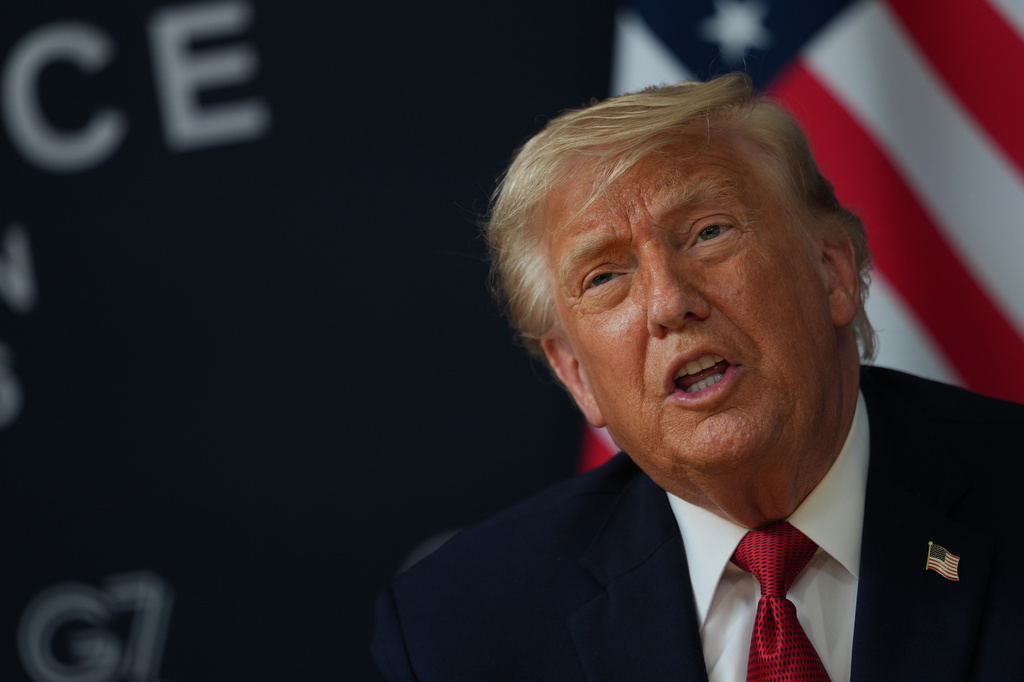
If Iran tries to move it, the U.S. will attack and “they’ll be gone. And they know that,” Trump said at a closing news conference at the Group of Seven summit in France.
There is a general agreement on what to do to “downblend” the uranium that is buried in the rubble of the bombed facilities, but details of who would excavate the material, who would dilute it and where the resulting material would go remain to be negotiated.
Asked how the deal ensures that Iran is permanently prevented from getting a nuclear weapon, Trump responded, “If it’s not permanently, we will bomb them.”
The draft deal says “the minimum methodology” would be dilution of the material on site under the supervision of the U.N. nuclear agency. Iran has long maintained its nuclear program is peaceful.
It took over a year and a half to get the previous nuclear deal
The 2015 Joint Comprehensive Plan of Action, or JCPOA, took more than 18 months to negotiate, starting with secret talks between U.S. and Iranian officials in Oman at the end of Democratic President Barack Obama’s first term.
They required dozens of direct high-level interventions from Secretary of State John Kerry and Energy Secretary Ernest Moniz, not to mention a team of dozens of technical experts traveling to Europe and elsewhere before the conclusion of the negotiations in Vienna.
Trump withdrew from the JCPOA in 2018 before most of its more contentious concessions had come into effect, and there is no indication now that Iran is willing to offer much more.
The JCPOA relied on very technical language and understandings, including limits on uranium enrichment, advanced centrifuges and heavy water production. In exchange, Iran was granted significant sanctions relief, amounting to billions of dollars.
As unhappy as critics were about the JCPOA — Trump called it the “worst deal ever negotiated,” while all Republicans and a number of prominent Democrats voted against it — all sides acknowledge it took more than 18 months to get to an even imperfect agreement.
Republicans say Congress must approve any deal
Republicans say any nuclear deal with Iran should be brought to Congress, as required by law. Sen. Ted Cruz, R-Texas, has said he “would certainly anticipate that” the Senate will get the final say.
Sen. John Kennedy, R-La., said he had little confidence Iran would abide by any agreement.
But Sen. Roger Marshall, R-Kan., one of a handful of senators who has spoken to Vance about the agreement, said the shortened timeline could be an advantage.
“Iran’s modus operandi is to negotiate for the purpose of delaying, so they can rearm themselves,” Marshall said Tuesday. “I think the president has to give them some type of a finite amount of time, or there’s going to be consequences. So I think it can be done.”
Sen. Tim Kaine, D-Va., noted that what could help Trump’s negotiators to hammer out a nuclear agreement in such a truncated timeline is that there is “a base” to work from following the Obama-era talks.
Still, the JCPOA “took years to put together. You had allies and even adversaries — China and Russia — around the table, you had the IAEA at the table, the Obama chief negotiator had a Nobel Prize in physics, Ernie Moniz,” Kaine said. “I don’t know that either Jared Kushner or Steve Witkoff have a Nobel Prize. So it’s going to be hard.”
Trump envoys Witkoff and Kushner, neither of whom had any prior experience in nuclear negotiations, made numerous but ultimately unsuccessful attempts to reach an agreement under Omani mediation during the first months of Trump’s second term.
There also is uncertainty about other issues besides nuclear that have been of concern to Arab countries, Israel, Europe and the United States. Issues such as Iran’s ballistic missile program, its support for militant proxies in the region or repression of its own people do not appear in the interim agreement.
It includes major concessions, such as Iran selling its oil freely, beyond the terms of the JCPOA. Only at the conclusion of the overall deal in 2015 were sanctions on Iran’s oil lifted.
“A deal is better than more fighting, but the war America and Israel prosecuted against Iran has fallen short of achieving its stated objectives,” said Brian Katulis, a senior fellow at the Middle East Institute. “This agreement is mostly about cleaning up an unnecessary mess and putting the best face on it.”
Associated Press writers Seung Min Kim and Nathan Ellgren contributed to this report.
Read more US strike on an alleged drug boat kills 1, leaves 2 survivors in the eastern Pacific Ocean
Read more QUIDNUNC: ‘Inspector’ Jurinsky wins the Tina Peters Prize for busting big ballot bologna
Read more Colorado Senate committee to investigate workplace harassment complaint