Researchers uncover racist police practices in 1960s Denver neighborhoods
This story was first published at Colorado Newsline.
DENVER | A Colorado commission overseeing the state’s racial equity study is preparing to accept proposals from organizations interested in conducting the economic analysis phase of the project.
A 2024 state law mandated the study, which is meant to determine the historical and ongoing effects of racism against Black Coloradans. History Colorado is nearing the end of its research, which focuses on the harms of racism in areas including housing, banking, employment, education, healthcare and criminal justice.
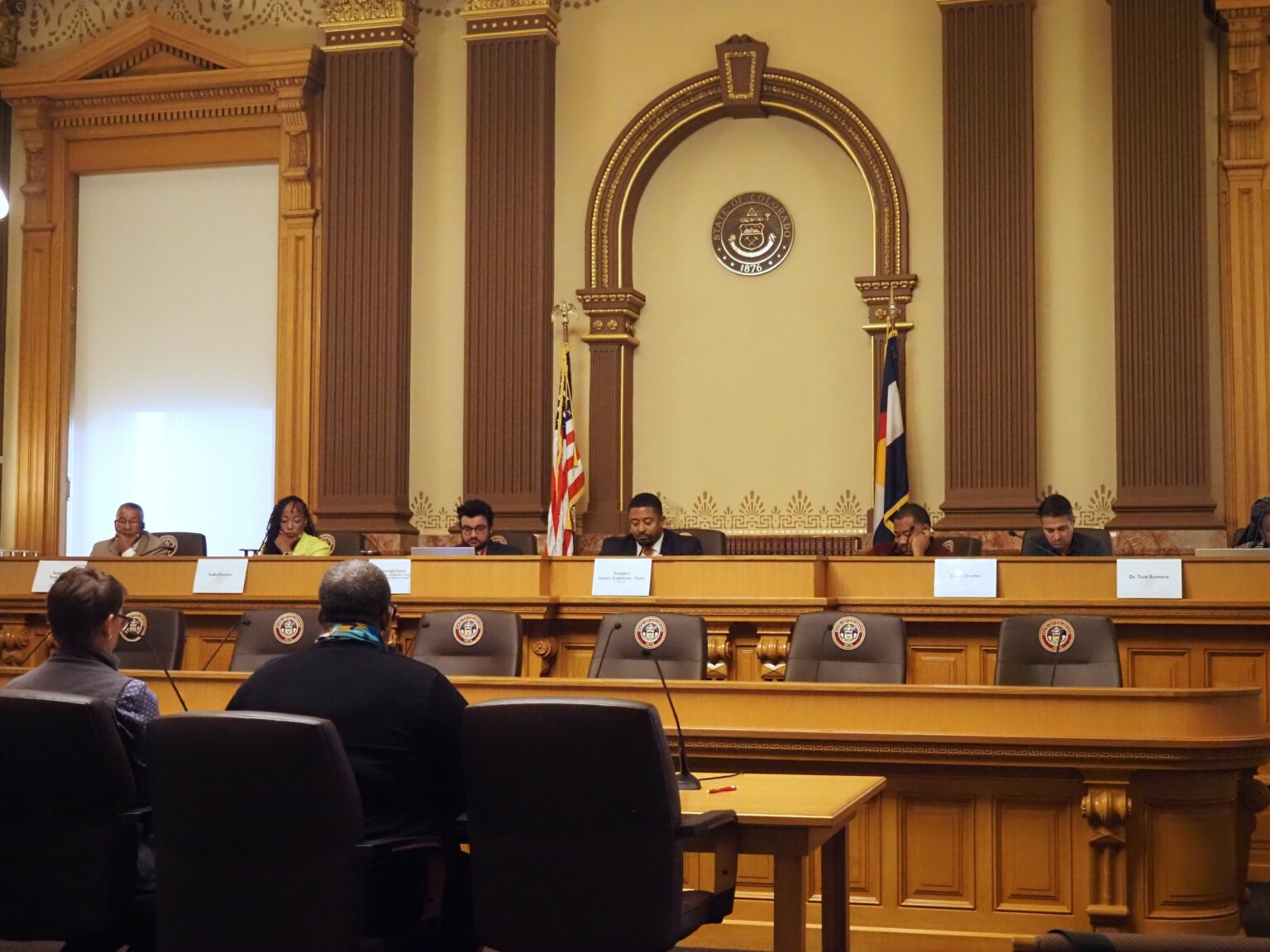
The Black Coloradan Racial Equity Study Commission, which is chaired by Colorado Senate President James Coleman, a Denver Democrat, will use the historical research and economic analysis to make legislative recommendations. The commission met at the Colorado Capitol Wednesday, where researchers shared updates on some of their findings.
The final component of the study is an economic analysis that will use the historical research to evaluate the impact of systemic racism on Black Coloradans. The commission will prepare its request for proposals at its next meeting in August. Commissioners will release the historical report at the same time as the economic analysis.
The bulk of the community outreach for the study is completed, Chloé Duplessis, a History Colorado program manager, told the commission, and research will wrap up in August or early September.
Researchers held listening sessions in cities including Denver, Pueblo, Colorado Springs, Boulder and Durango throughout the last year, where community members repeatedly expressed gratitude for the study and for their inclusion in it, according to Duplessis.
“We did this very intentionally to honor the fact that it’s important to hear from people who oftentimes are not included in any planning efforts or historical efforts of this nature, and what we heard repeatedly from them, our fellow citizens, and from our partners, is “thank you,”” Duplessis said.
Members of the research team will present their findings at conferences in Colorado and around the country throughout the rest of the year.
Researcher Melissa Jones said the team drafted five chapters that range from Colorado’s days as a U.S. territory to the 1960s. They completed research on Colorado’s criminal justice system, the presence of Black Coloradans in outdoor recreation and the effects of desegregation and resegregation within Colorado schools. They are still finishing later parts of the report, including information on jobs and businesses from the 1960s forward.
Community donors funded the study since the law did not allocate state funding. Donations are made to the group Collaborative Healing Initiative within Communities and then funneled to the state’s treasury department to pay for the work. The study is expected to cost a total of $1.8 million.
New findings
In the early 1960s, real estate agents in Denver began to show homes in the Park Hill neighborhood to Black Coloradans. Jones said when real estate agents began allowing Black residents to purchase homes there in 1960, the population in Park Hill was 98% white. By the end of the decade, that statistic flipped, and the population in Park Hill was 90% Black.
When President Lyndon B. Johnson visited Denver in 1966, Jones said Park Hill was touted to him as “the model of integration,” while in reality it was the opposite. Jones said it was “one of the most extreme cases” of white people migrating out of areas becoming more diverse.
Education and employment opportunities for Black Coloradans were more limited at the time, too. Then, law enforcement officers, many of whom Jones said were formerly connected to the Ku Klux Klan, policed Black neighborhoods like Five Points and Park Hill more heavily, targeting young Black men with petty crime charges like jaywalking.
“Once they had a police record, they couldn’t access the jobs that they so desperately wanted and needed,” Jones said. “You can see sort of the ways that a lot of the things that we’ve been looking at — whether it’s education, criminal justice, housing — those begin to overlap and the harms just begin to pile up.”
Data from the organization Mapping Police Violence showed that in 2020, Denver had the highest rate of fatal police shootings out of the largest 25 cities in the nation with an average of almost 10 fatal shootings per 1 million residents, Jones said. Black, Latino and Native people were represented at “significantly” higher rates than white people. In 2022, Colorado ranked seventh out of all states for police killings, Jones said.
“I think it’s interesting that from 1929 to 2026, we’re still dealing with the same issues as it relates to law enforcement in the Black community,” Bianka Emerson, a commission member and president of Colorado Black Women for Political Action, said.
While it can be hard to directly compare data on incarcerated men to data on incarcerated women, Jones said the overrepresentation of Black women in prisons in Colorado was more pronounced than it was for Black men in the early days of Colorado’s corrections systems.
Jones also talked about another report that looked at how school choice in Colorado has potentially resegregated and “created other forms of inequity” based on where people live and how far they have to drive to get to the school of their choice.
At a community forum during the week of Juneteenth, Jones heard a mother ask a question about how she has to make a decision she doesn’t want to make: Should she send her daughter to a school that has better opportunities, but is far away from home and has students who don’t look like her; or should she send her to a school with fewer opportunities that is closer to home and has students who look like her.
State Rep. Jennifer Bacon, a Denver Democrat, said that’s a question her own parents asked when she was a kid deciding where to go to school.
Duplessis said it’s “sobering” to learn more about what Black Coloradans have experienced throughout the state’s history. But her team of researchers and historians remains optimistic because for every “heavy, heavy, heavy instance of harm” they’ve uncovered, they’ve also seen community “rise to the occasion,” cosigning for mortgages, providing jobs, teaching and feeding people.
This story was made available via the Colorado News Collaborative. Learn more at https://www.google.com/url?q=https://colabnews.co&source=gmail-imap&ust=1784230859000000&usg=AOvVaw3lqqoM0rJJTlXuplzFMnm4
Read more Family demands an independent probe after ICE officer fatally shoots a man in Houston
Read more Aurora traffic enforcement cuts crashes by 86% at crash-prone I-225 and Parker interchanges
Read more What to know about protecting pets from the New World screwworm fly
