Super PACs pour millions into Colorado races, raising campaign finance concerns
This story was first published at Colorado Newsline.
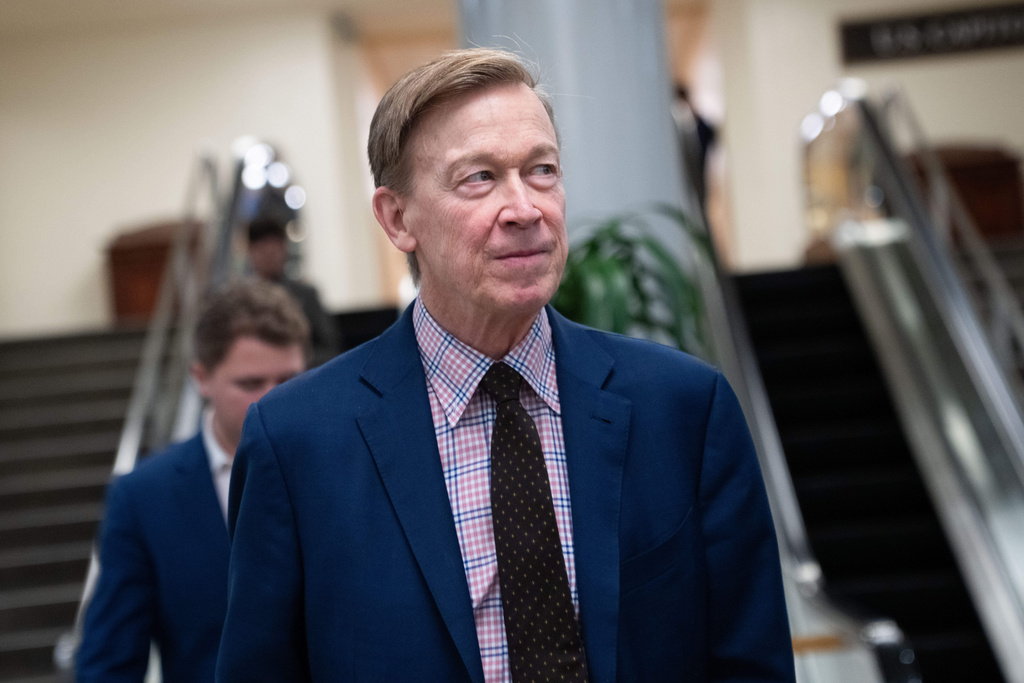
DENVER | A political action committee whose donors won’t be disclosed until after Colorado’s June 30 primary spent $300,000 last week to aid incumbent Democratic U.S. Sen. John Hickenlooper, who faces a primary challenge from state Sen. Julie Gonzales.
Common Sense Action Fund, a so-called super PAC that can raise and spend unlimited sums of money from individuals, corporations and nonprofits, was registered in late November, just before Gonzales made her rumored Senate candidacy official.
As of its most recent Federal Election Commission filing in April, Common Sense Action Fund had raised just $7,000 from three donors: former Democratic state Rep. Edie Hooton, former U.S. attorney and Hickenlooper adviser Cole Finegan, and Broomfield resident John Bass. But the super PAC last week spent much more than that — $11,500 on website and media production and $288,500 on digital advertising — to boost Hickenlooper’s candidacy.
It disclosed those expenditures in an itemized notice to the FEC on June 18, as required by federal law. But the super PAC is not required to report its fundraising since April 1 until the next quarterly filing on July 15 — two weeks after the outcome of the Hickenlooper-Gonzales race is decided.
A website published by Common Sense Action Fund, HickFightsBack.com, praises Hickenlooper for “standing up to Trump’s cruel agenda,” specifically when it comes to immigration.
It closely mirrors language published in a recent update to Hickenlooper’s campaign website — in a “redbox” used by campaigns to send signals about strategy and messaging to super PACs supporting the campaign.
“Coloradans who vote in Democratic primaries and Coloradans under 50 need to see that John Hickenlooper is fed up with Donald Trump and (Immigration and Customs Enforcement’s) violence and cruelty and fighting to reign in the out-of-control agency,” the redbox text began.
The U.S. Supreme Court’s 2010 decision in Citizens United v. FEC cleared the way for super PACs, which have come to account for an increasingly large share of spending in competitive political races. Super PACs are legally prohibited from coordination with candidates or their campaigns, but proponents of campaign finance reform have been increasingly critical of redboxing as a workaround tactic. A bill to ban redboxing, H.R.2476 or the Stop Illegal Campaign Coordination Act, has the support of a handful of congressional Democrats, but no Republicans.
Gonzales’ website also features a redbox section containing photos and videos for use in ads and a research memo to “interested parties” highlighting Hickenlooper’s perceived vulnerabilities.
Since June 5, she has received a total of about $164,000 in super PAC support, most of it from the Working Families Party PAC, a large national group whose donors include unions, nonprofits and progressive donors. Indivisible Action, an arm of the national progressive activist organization, and a newly registered group, Young People for a New Era, have also spent $16,881 and $18,872 on Gonzales’ behalf, according to FEC records.
Hickenlooper’s campaign did not respond to a request for comment. In a statement, Gonzales called Citizens United “a disastrous court case that has unleashed billions in our elections year after year.”
“If a bill was introduced in the Senate to make it harder for corporations and billionaires to buy our elections, I would certainly support that bill,” Gonzales said, “and so should every Democrat who says they are running to protect our democracy.”
Highly specific statements
The Campaign Legal Center, a nonpartisan organization that advocates for campaign finance reform, found that more than 200 candidates for federal office used redboxes during the 2022 campaigns. A typical redbox takes the form of a standalone section on a candidate’s website describing “what voters need to know,” including information about demographic targets and methods of communication.
As the tactic has grown more common, however, “redboxing has become more egregious over time,” the Campaign Legal Center wrote last year. Pages that once contained B-roll footage and “key messages” for targeted voter groups now often feature highly specific, continuously updated statements about preferred campaign strategies.
As they battle for the Democratic nomination in Colorado’s 8th Congressional District, both state Rep. Manny Rutinel and former state Rep. Shannon Bird are making extensive use of redboxes, as each benefits from millions of dollars in super PAC support.
“5/21/26 update remains important: all video content should tell voters what Bird’s ICE vote did,” read Rutinel’s redbox earlier this month. “Content should explicitly mention Bird by name each time the vote is discussed.”
“6/4/26 update: TV, digital, and mail messaging should continue to reflect the messaging as outlined below. Added SMS, and a note on endorsements,” the campaign subsequently wrote.
Four days later, Latino Victory, a national group backing Rutinel, announced “an additional $1,000,000 TV/Digital/Text primary election ad campaign to boost Manny Rutinel” in the 8th District race. Two super PACs associated with Latino Victory have spent more than $3 million to support his candidacy this year.
Bird’s campaign website features similarly precise instructions. She has received a total of about $1.7 million in support from the groups Women Vote, Elect Democratic Women, Pro-Choice Majority and WelcomePAC.
“June 2 Update – From Weeks 3-1, it is critical that voters see the below contrast messaging on television. If budget allows for double-tracking, voters should also see a positive spot,” Bird’s website reads. “It is also critical that voters continue to see contrast messaging on YouTube, CTV/OTT, and in the mail (for people who have voted in at least 1 of the last 4 Democratic primaries, as well as newly registered Democratic voters), as well as positive messaging on Meta and Google Search.”
Neither Bird’s nor Rutinel’s campaign responded to a request for comment on redboxing, or whether they’d support legislation to ban it.
Lopsided 1st District spending
The most lopsided super PAC spending spree of the 2026 primary has come in Colorado’s other competitive Democratic House race, for the 1st District seat held by longtime U.S. Rep. Diana DeGette.
Both DeGette and her top opponent, democratic socialist and first-time candidate Melat Kiros, use redboxes, though DeGette has received far more support — over $1.2 million — than the $285,032 spent by left-wing group Justice Democrats to back Kiros’ candidacy. A third 1st District candidate, University of Colorado Regent Wanda James, trails in fundraising and polling and hasn’t received super PAC support.
“Likely voters searching for Melat Kiros should know she is endorsed by Sen. Bernie Sanders and stands for Medicare for All and fighting Trump,” reads Kiros’ website.
“Super PAC money has become baked into how modern campaigns operate, and as long as super PACs are legal, campaigns will find legal ways to communicate with them,” Kiros said in a statement.
“H.R. 2476 would close one specific door, and I’d support it, but banning one workaround won’t fix a fundamentally broken system,” she added. “That’s why I would support the Abolish Super PACs Act introduced by Sen. (Bernie) Sanders and Rep. (Summer) Lee. Not regulate. Not reform. Abolish.”
A spokesperson for DeGette did not respond to a request for comment.
Groups spending on DeGette’s behalf include Pro-Choice Majority Action, a PAC linked to Elect Democratic Women; Project 218, which has spent on behalf of other incumbent or moderate candidates in other Democratic House primaries across the country; and the Mile High Accountability Project, a newly registered group.
The Mile High Accountability Project filed a statement of organization with the FEC on April 29, and reported $350,000 in independent expenditures on DeGette’s behalf on June 8. But like the pro-Hickenlooper Common Sense Action Fund, it won’t have to disclose its donors until mid-July, after the primary has concluded.
“These aren’t advocacy groups funded by small donors who believe in something,” Kiros said in her statement. “These are pop-up operations that materialize when an entrenched politician is in trouble; they spend whatever it takes, and then disappear before voters know who was behind them.”
A “Voters Need to Know” page accuses Kiros of “pushing an extreme agenda” that includes “withdraw(ing) the U.S. from NATO.” That claim — which Kiros called “ridiculous” and “a lie” during a candidate forum Friday — subsequently appeared in super PAC ads attacking Kiros.
“We won’t even know who’s making those ads, because it’s an anonymous super PAC,” Kiros said Friday.
“I don’t know what outside groups are doing, anything like that,” DeGette said in reply.
DeGette’s website, however, currently features direct references to the names of the super PACs spending to support her candidacy.
“Pro-choice and Project allied groups should continue messaging on television and digital,” DeGette’s website says. “New allies should know that voters who have not returned their ballots need to see contrast communications in the mailboxes — followed by TV and digital targeted to likely voters 40+.”
This story was made available via the Colorado News Collaborative. Learn more at https://www.google.com/url?q=https://colabnews.co&source=gmail-imap&ust=1782934649000000&usg=AOvVaw3Wn9i6FN3cnhXkzKD5gFh0
Read more Jeep Cherokee vs Subaru Forester: Edmunds sizes up hybrid SUVs
Read more The world of extreme pogo is an eye-popping blend of artistry, courage and ‘mystical zest’
Read more What is the 2026 song of the summer? AP offers some predictions
