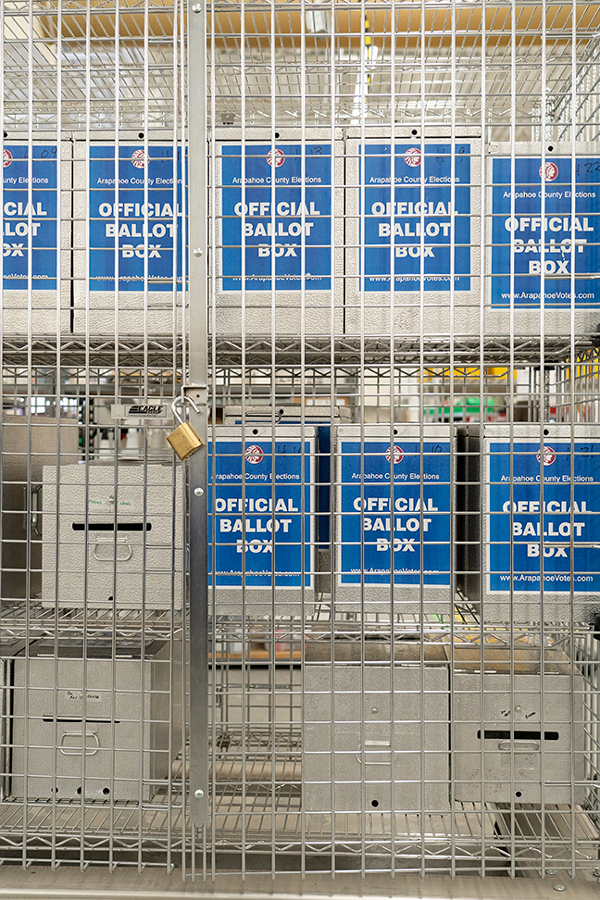
Arapahoe County, state election officials defend voting accuracy amid conspiracy theories
AURORA | It’s voting season again, and controversy about voting accuracy, so it’s time for a rundown of what goes into an election in Colorado.
Some, like former Aurora City Councilwoman Danielle Jurinsky, have already cast some doubt and offered conspiracy theories on the accuracy of elections in Aurora.
Jurinsky created controversy in a Facebook post questioning why the Arapahoe County Clerk sent three ballots with return envelopes to her house for three voters, but one was a different color than the other two. Jurinsky intimated that it allowed for the clerk, a Democrat, to identify Republican voters. “Are Republican ballots being flagged?“ Jurinsky asked in her post.
Clerk officials posted a response on the Facebook missive, pointing out that there are no difference in color for Democrat and Republican return envelopes, only unaffiliated voter envelopes, so that election workers can ensure those voters comply with state law regulation primary elections and vote only a Democratic Party ballot or a Republican Party ballot, but not both.
Local and state election officials repeated that not only are Colorado elections secure, but that they are provably accurate.
Matt Crane, former Arapahoe County Clerk and current Executive Director of Colorado County Clerks Association, said he wanted Colorado voters to know that the voting process here is one of the most secure in the country.
“I think [Colorado’s election process] is very safe,” Crane, a Republican, said in an interview. “Our processes are amongst the most secure and mature for processing mail ballots in the country. In 2018, the Washington Post said Colorado was the safest state to cast a ballot because of all the security measures we do, both around eligibility and tabulation and chain of custody.”
Crane said that voter rolls are checked daily against other data sets from the Secretary of State, the DMV, local sheriffs, and county coroners to keep the rolls up to date.
Crane said voters should “vote with confidence that our process is safe and secure.”
Sentinel Colorado spoke with the election team at the Arapahoe County Clerk and Recorder’s office, who shed some light on the safety and procedures of Colorado elections.
There are 409 different voting precincts in Arapahoe County, meaning there are numerous ways ballots are configured based on state legislative districts, county commissioner seats, and other local elected positions.
Bill Mast, the director of Arapahoe County’s election division, said that once the county receives ballots, they are input into a machine called Agilis, which can “process about 18,000 envelopes an hour”. Agilis then starts the process of automatic signature recognition, where the program looks at all signatures on file for a voter, both from the secretary of state’s office, the department of voter vehicles office, and any other official signatures. The software used is similar to that used by banks to verify signatures on checks.
According to Mast, the machine typically clears about forty percent of signatures, and those ballots are sent off to be counted. The other sixty percent then go into a three-tiered review process.
“[Signatures] that don’t pass the confidence threshold get sent to Tier 1 review,” Mast said. “That’s when a trained election worker is going to review it and say, ‘OK, I have the exact same signature the machine was looking at. This is the most recent signature, and I have the envelope that the voter returned.’”
If that election worker can’t say with confidence that the signature matches, the ballot goes on to Tier 2 review.
“That’s a bipartisan team of election judges,” explained Mast. “If one of the two says, ‘Yes, that signature looks good.’ The ballot proceeds to get counted.”
If one judge gives the ballot approval, the county sides with the voters’ ballot and sends it off to be counted; however, Mast said that in instances where both judges cannot confidently say that the signature belongs to the voter, the ballot moves to Tier 3.
When a ballot hits Tier 3, the process becomes more involved. Voters will be sent a cure letter, allowing them to explain why their signature looks different and verify that the ballot is, in fact, the one they cast. Voters do this by sending a copy of their ID or going into an in-person voting station with their ID.
If the voter doesn’t respond to the cure attempt at all, the case gets referred to the district attorney’s office, which will further investigate the matter.
Mast said his team “reviews every envelope that comes into the building within 72 hours” or the equivalent of three business days, adding that they typically do it within 24 hours of a ballot being received.
If the voter is subscribed to the ballot track system, which roughly two-thirds of Arapahoe County voters are, they will receive either an email or a text on the status of the ballot.
“The vast majority of the cure responses come back digitally,” Mast said. “If their ballot is rejected for a curable reason, you’ll be able to click [a link we send you], take a photo of their ID, check the box, and sign on their phone, and they’re done.”
Other voters respond by mail or come into a physical location. Voters have until eight days after an election to get their ballot cured.
According to data from the Arapahoe County Clerk and Recorder’s office, they have currently received 40,293 ballots, with 190 awaiting cure. Voter turnout of the county’s 422,037 registered voters currently sits at about 9.5%.
The vast majority of ballots are sent via dropboxes or by mail. There are seven days left until the primary.
Debunking myths
Despite frequent, unproven claims by President Donald Trump and other election deniers, research and evidence regularly shows that there is not widespread voter fraud in any election in the nation, including Colorado.
Only US citizens are allowed to vote in Colorado elections, and undocumented immigrants are not included in Colorado’s automatic voter registration process.
If you are registered to vote in one county, but drop off your ballot in another, it may still be counted. Counties in the Denver metro area exchange ballots daily with one another when they receive a ballot from another county, according to the Mast.
Colorado is a member of the Electronic Registration Information Center, a nonprofit, nonpartisan organization to assist states in maintaining voter rolls and detecting possible ineligible voting. As part of this organization, along with 26 other states and the District of Columbia, Colorado can identify when a voter moves to a different state or jurisdiction. The nonprofit is composed of a bipartisan group of election officials from each member state.
If you are interested, the Arapahoe County Elections Division offers public tours of the election facility, and both Mast and Crane encouraged voters to reach out to their county if they have questions regarding the voting process.
Arapahoe County has also put out several videos going over the various procedures and tests that they go through to explain the voting process.
For details about local and state races, see the Sentinel Colorado 2026 Primary Election Voter Guide.
Read more From peace talks to Pennsylvania: Trump visiting Mack Truck facility
Read more Trump is the frontman for his own party as rival groups vie to shape America’s 250th anniversary
Read more Senate passes a bipartisan housing bill aimed at increasing supply and lowering prices
