Another swell of outside political spending seeks to shape Democratic primaries in Aurora
AURORA | As spending in state legislative and regional primary races has swelled this cycle, much of it has been aimed at boosting candidates dubbed more moderate over thier more progressive Democratic counterparts, including Aurora incumbent representatives and local county commissioner candidates.
Nearly $2 million in outside spending has poured into Colorado’s Democratic primaries this year, much of it routed through organizations that do not disclose their donors, according to multiple recent media reports.
This year’s spending focuses on a handful of statistically safe Democratic seats across metro Denver. In the past few years, primary races in some of these safe “blue” seats have turned into some of the most expensive contests in the state. This effort highlights just how important Democratic statehouse and local primaries have become for the Colorado government. As Democrats hold on to their majorities at the state Capitol for almost a decade, these primary races now function as the main battleground for control of legislative priorities.
Experts and others watching say the trend appears to be an effort to persuade voters to choose Democratic candidates deemed friendly to business and less likely to support business and industry regulations.
Much of the recent swell of money is being spent on mailers and attack ads funded through a network of state-level super PACS and nonprofit organizations, some with names that resemble progressive grassroots political groups but critics say are not. This dark money has paid for ads and mailers in legislative and county-level races across the metro area and one race in the Western Slope, according to campaign finance reports filed for fundraising and spending through June 10.
The spending surge reflects an escalating ideological fight over the direction of Colorado’s dominant political party. Outside groups aligned with more moderate Democrats have poured money into a handful of safe Democratic districts, while labor-backed organizations have spent heavily to support candidates on the party’s more progressive wing.
Historically, candidates backed by One Main Street Colorado have gone on to join the newly formed Opportunity Caucus, a pro-business and entrepreneurship group of legislative Democrats, which is currently under investigation by the Colorado Independent Ethics Commission for allegedly accepting payment from One Main Street for luxury resort expenses from a retreat with lobbyists in Vail last October. The event and controversy were first reported by The Colorado Sun.
In House District 41, for example, a committee called Fighting For A Better Aurora, which received money from One Main Street Colorado, has spent nearly $90,000 on mailers and advertisements supporting Aurora Public Schools Board of Education Member Anne Keke and opposing incumbent Rep. Jamie Jackson.
Keke currently serves on the Aurora Public Schools Board of Education, which she was re-elected to last year. Now running against State Rep. Jamie Jackson, she is primarying Jackson, who was appointed to represent HD 41 following a vacancy two years ago.
Keke answered a call from the Sentinel while canvassing homes in the district. She said that the debate over PAC spending has turned into “mudslinging”.
“The smearing, the mudslinging at me, I don’t respond because that’s not what voters want to see,” Keke said. “What they’re concerned about is how we can bring affordability back, costs of living down in Aurora, how we can safeguard healthcare, and how we can bring stability amongst ourselves.”
Click here for full local election coverage in the Sentinel Colorado Primary Voter Guide.
Keke said that she has filled out questionnaires sent by organizations such as One Main Street and the Working Families Party, but that she supports efforts to make political funding more transparent.
In an interview, Keke said she “believes that voters should know the original sources of funding behind” independent expenditures. Keke called the explosion of dark money in Colorado politics “unfortunate,” but hardly new or unique to her race, saying she has seen it support candidates across party and ideological lines.
“It’s on both sides of this race,” Keke added. “I would support all individual contributors to campaigns… [to be] reported. We require this for SDCs, PACs, and candidates, and I think we should do the same for the donors to C4s and unions.”
Keke said she had not communicated with One Main Street nor any independent expenditure groups supporting her campaign, but that she filled out “dozens of questionnaires for organizations that support or oppose my candidacy.” Keke added that she believes in communicating with “all interested parties, whether or not they would support me.”
In terms of campaign finance reforms, Keke said she would “require individuals’ contributions to SDCs and PACs be disclosed and ban lump-sum transfers into these accounts that lack any contributor details.” Keke further called for the Citizens United decision to be overturned, but that is more of a federal issue than a state-level one.
Jackson, who has received the backing of Colorado Labor Action, pointed to recent reporting that One Main Street had received donations from a group funded by the oil and gas industry.
Jackson told the Sentinel she received a survey from One Main Street, but declined to fill it out, citing her belief that the organization takes oil and gas money.
Jackson said she was “looking at policies” being adopted in Hawaii as a way to curb corporate spending in politics.
Jackson told the Sentinel that pro-consumer bills she has worked on have died in committee, in part due to disagreements with the Opportunity Caucus. She was one of the prime sponsors of HB26 12-71 that would have created a fee on manufacturers and wholesalers of alcohol to fund impact and recovery projects across the state.
Jackson said that while she had “good working relationships” with Opportunity Caucus members, she found it “frustrating” when they could not align on policy.
Candidates in the Democratic primary in House District 42 tell a similar story. Sarah Woodson, a community activist and founder of The Color of Cannabis, which she describes as “the nation’s first licensed cannabis tours, transportation, and party bus company — is running against incumbent State Rep. Mandy Lindsay. Woodson said that, similarly to Keke, she had filled out a questionnaire from One Main Street, but that she also supports transparency measures.
“I definitely want to mandate that these independent expenditures disclose their donors,” said Woodson, who added that she was also looking at Hawaii’s new corporate spending laws.
In an interview with the Sentinel, Lindsay said that the public should have access to information on the original sources of funding behind independent expenditures.
“The public should be able to have that information, even candidates, we should be able to know… where this money is coming from because it can be so powerful in the outcomes,” Lindsay said.
In her race in particular, Lindsay said she thinks the amount of spending going in the race is unusual.
“This amount of money, I have not seen in HD-42 politics since I became active,” she said.
Lindsay argued that the spending itself signals a clear contrast between candidates.
“What [this spending] is doing is it is showcasing that there is such a difference between myself and my opponent. Because if there wasn’t, if it were the same policy-wise, they would not be spending this money here, they would be spending it somewhere else in some other district,” Lindsay said.
Keke, Woodson, Lindsay, and Jackson have all been endorsed by one or more members of the Opportunity Caucus.
Network of PAC Funding
A similar funding war defined the 2024 primary in Colorado, which saw outside groups spend $5 million to influence the Democratic legislative races. This recent bout of spending is part of a larger tug-of-war for ideological control over Colorado’s dominant political party, which holds a near-supermajority in the state legislature.
”As someone who experienced almost $800,000 of untraceable dark money against me in 2024, personally, it is a very jarring experience to have gone to work for your community for years,” said Sen. Mike Weissman, who was the target of a dark money campaign in his bid for state Senate. “All of a sudden, there’s money pouring in from Washington, D.C. — super PAC or a shell corporation in Delaware trying to snuff you out, politically speaking.”
Weissman, as a House representative and member of the state Senate, has a long history of supporting legislation protecting the rights of consumers and promoting accountability among businesses and industries. He and other Democrats targeted by One Main Street say the PAC controversy is about businesses trying to do an end run on unsuccessful lobbying efforts using cash to influence elections.
One Main Street Colorado, has been the common denominator behind all of the dark money groups and state super PACs that have cropped up in the Democratic primaries, according to the group’s critics and state election records. The nonprofit doesn’t disclose its donors and has played a significant role in the Democratic primaries for election cycles going back to 2020. One Main Street, along with recently formed nonprofits Fair Economy for Coloradans and the Colorado Affordability Project, has been funding some of the state super PACs. Federal law, however, precludes election PACs from coordinating with candidates during campaigns.
The Sentinel reached out to Andrew Short, One Main Street’s executive director, but did not receive a response. During a 2024 primary, The Denver Post interviewed Short, and he denied allegations that One Main Street was funded by the oil and gas lobby. Public filings, however, show past donations linked to groups in that industry.
During the 2024 election cycle, which saw similarly well-funded primaries, One Main Street was the largest recipient of donations from “Coloradans for Progress”, according to tax filings. That group has received $2.2 million from Chevron and $1.1 million from Coloradans for Responsible Energy Development. One Main Street has also had significant past donations from Xcel Energy and the Apartment Association of Metro Denver.
Although some of One Main Street’s affiliated political committees have funding from several trade unions, like Plumbers Local 3, the bulk of its financial backing is not publicly disclosed.
Through June 10, the committee raised around $800,000 and has spent roughly $51,000.
According to campaign finance data compiled by The Colorado Sun, seven other groups backed by One Main Street and Fair Economy, which have often deployed naming conventions common in progressive circles, are:
- Colorado Mountain Progressives received roughly $150,000 from One Main Street PAC. It has primarily spent money running campaign ads in House District 13, which encompasses Grand and Summit Counties, but has also spent money opposing Lindsay.
- Fighting For a Better Aurora, which has received $250,000 from One Main Street super PAC. The committee has sent out mailers in House District 41 supporting Aurora Public School Board member Anne Keke’s campaign to unseat Rep. Jamie Jackson (D-Aurora. It has also supported Democrat Maya Wheeler in her race against Arapahoe County Commissioner Leslie Summey.
- Promoting Progressive Women received $180,000 from One Main Street Colorado’s super PAC and $50,000 from the Colorado Affordability Project nonprofit. The PAC is running ads opposing Rep. Mandy Lindsay of Aurora, who is currently running for reelection. The PAC is also running ads supporting
- Adams County United received $280,000 from Fair Economy for Coloradans to support state Rep. Jacque Phillips’ reelection against primary challenger Gabriel Cervantes, a liberal organizer.
- Blue Collar Progressive received $350,000 from One Main Street PAC. It has spent money in support of a variety of Democrats in various primaries: Jillaire McMillion, running in House District 19 in Boulder County; Cherry Creek School District Board Member Angela Garland, who is running to unseat incumbent Arapahoe County Commissioner Jessica Campbell; and Karen DeArguero, who is running for a seat on the Adams County Commission.
Colorado Mountain Progressives, Promoting Progressive Women, Adams County United, Denver Progressives United, and the Progressive Leadership Fund are all registered to Jimmy Dickson in Durango. Dickson has previously run the campaigns of two state lawmakers, including Westminster Democrat Shannon Bird, who is currently running for Congress. Bird co-founded the Colorado Opportunity Caucus, which is also supported by One Main Street.
The Opportunity Caucus is currently involved in a lawsuit that claims it violated the Colorado Open Records Law when it denied a records request relating to its Vail retreat.
Tensions between Opportunity Caucus members and more liberal Democratic members of the Legislature have risen after a bill attempted to force nonprofit caucuses to reveal their donors and spending.
Labor Groups’ Spending
Although the public doesn’t know who is funding organizations like Fair Economy Coloradans, One Main Street Colorado, and the Colorado Affordability Project, there is money being spent to counter that is more transparent.
A state-level super PAC funded by unions, Colorado Labor Action, a coalition of some of Colorado’s largest labor unions, has sent more than $570,000 since May 1 to several of the contested Democratic statehouse primaries as a countermeasure to dark money campaigns. The interconnected PACs affiliated with One Main Street and Fair Economy for Coloradans have spent almost double that in their bid to back moderate candidates.
A vast majority of the PAC’s money this cycle comes from the AFL-CIO ($100,000), Colorado Education Association ($350,000), American Federation of Teachers ($130,000), and the SEIU.
Union donations come from a voluntary contribution to unions’ Committee on Political Education Fund (COPE), as member dues can’t be used for campaign contributions.
Dennis Dougherty, the executive director of the Colorado AFL-CIO, told the Sentinel that the AFL-CIO condemns what he described as an attempt by dark money to “take over” the Democratic Party.
“The Colorado AFL-CIO unequivocally condemns the infiltration of unaccountable corporate dark money’s coordinated attempt to take over the Democratic Party and prioritize the wants of corporations and billionaires over the needs of working people,” Dougherty said. “That kind of secret money doesn’t just corrupt politicians. It corrupts policy.”
“There is no doubt that if we continue to allow growing corporate influence over our elected officials, we will continue to see legislation that further erodes worker and consumer protections,” he continued. “We are proud to be backing candidates this cycle who are standing up for working people against dark corporate influence. Unlike these shady groups, we are transparent about our donors. We are confident voters would prefer candidates backed by working people to corporate-backed lies.”
Colorado Labor Action has spent more than $810,000 in this current election cycle, with money going to ads and materials for Halpern, Nguyen, Garcia Irlando, and Jackson.
State legislators from Aurora, including Lindsay, Jackson, and Weissman, will be holding a virtual town hall on the subject of dark money in politics on June 23 at 5:30 PM.
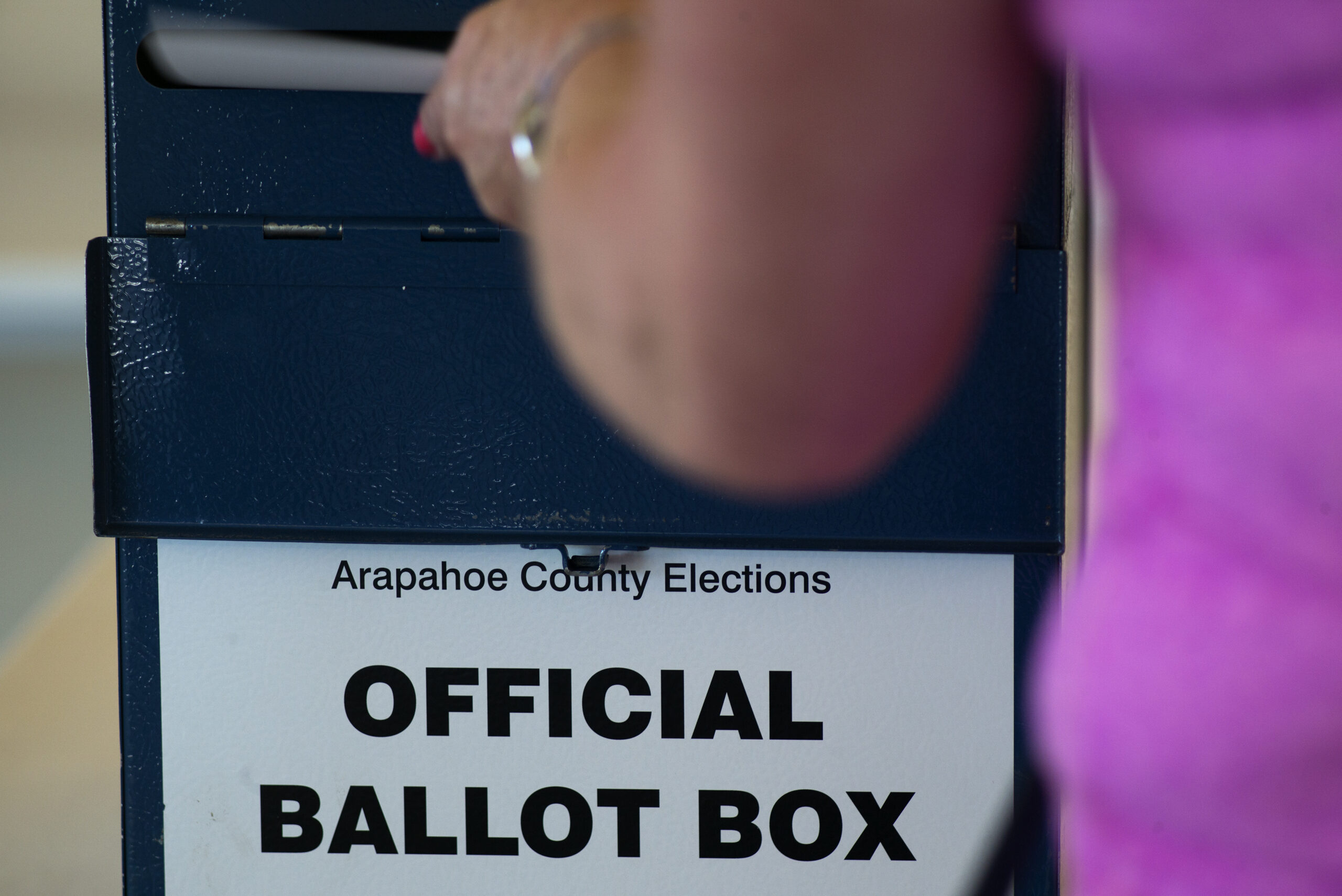
The primary is June 30, and ballots have already been mailed to voters.
Read more Trump-endorsed de la Espriella holds slim lead in Colombia’s election as his rival challenges vote
Read more Extreme heat expected again at the Grand Canyon after 3 hikers die in heat-related incidents
Read more Utah marks a year of battling measles, with no clear end in sight