ARMSTRONG: Test scores show Colorado schools still falling well short
If you spent $15,000 on a new roof and it leaked, what would you say if the contractor replied, “Well, nearly half of your roof didn’t leak! And your roof actually leaks less than a roof we installed last year. So you should be thanking us!” I’m going to go out on a limb here and guess you would not be very satisfied with such service.
Yet, when it comes to public education, many Coloradans routinely accept abysmal results without so much as blinking.
Colorado schools still failing
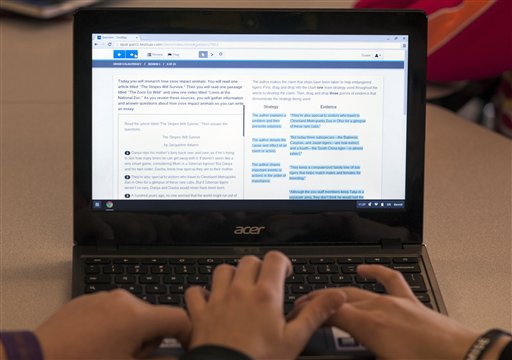
Chalkbeat recently published preliminary results from the latest Colorado Measures of Academic Success (CMAS) tests. Here’s how the headline spins the results: “Student math proficiency rises but literacy results are mixed.” A more accurate headline would be, “Colorado student achievement remains in the toilet as schools utterly fail to educate many students in math and literacy.”
Sure, math proficiency “rose” this year—to 39% in fourth grade and 37.8% in eighth grade. This is like bragging that your F in class is slightly less bad than the last F you got. Hurrah, I guess. English proficiency was somewhat higher, at 47% in fourth grade and 42.2% in eighth grade. Put another way, over half of students cannot read at grade level.
True, the eleventh grade SAT, which uses different metrics, suggests that in language 59.6% of students who took the test are “college ready” (while in math only 31.6% of students are). For more context, see Colorado results from the National Assessment of Educational Progress.
Meanwhile, taxpayers are on the hook for $15,805 per student, for a total of $13,926 billion (as of the 2023–24 fiscal year), to finance the public school system. If a private roofing contractor performed so poorly, Phil Weiser probably would investigate the company for fraud. But I guess we have much higher standards for roofs than we do for the education of children.
A broader discussion
I do think the CMAS results give us good reason to be alarmed about the state of the public schools. And we haven’t even seen this year’s disparities by race/ethnicity, which, judging from previous years, will be dramatic.
On the other hand, my comparison with roofs has some obvious limitations. Putting on a roof is a one-time, short-term job, and it’s either done right or not. Education is not like that. Education is a multi-year process, students move around a lot, some students are naturally more academically oriented, some students struggle with dyslexia or other neurological issues, and some students come from difficult family circumstances.
Plus, education is a multifaceted enterprise, so maybe standardized tests aren’t a good way to measure education achievement in any broad sense. A child may be excellent in music, sculpture, or empathetic treatment of friends and yet score poorly on a given test.
Plus, some students are doing quite well. I don’t think anyone worries about students managing Advance Placement classes or the International Baccalaureate program. And some schools have outstanding results. For example, in 2025, an astonishing 94.7% of students at Boulder’s High Peaks Elementary met or exceeded expectations in language, while 92.5% did in math.
Standardized tests are so unpopular that the legislature cut the social studies portion of the CMAS to a single grade. Another bill sought (per the summary) to “ensure that standardized summative assessments are administered to students to the minimum extent possible.” That bill lost.
Plenty of people argue that standardized testing makes education worse by encouraging schools and teachers to “teach to the test” at the expense of other meaningful experiences. In the homeschooling world (my wife and I homeschool our ten-year-old), I’ve heard parents say that one reason they don’t like the regular schools is their “drill and kill,” “teach to the test” atmosphere.
I would respond that, insofar as we’re talking about taxpayer money, standardized testing is the only way to give taxpayers any meaningful information about how schools are performing.
Speaking of homeschooling, although my ten-year-old scores in the top one percent on the California Achievement Test, I don’t claim my family’s experiences are representative. In March, Brian Ray argued that on balance available studies “show homeschool students outperforming institutional school peers on academic tests.” But he acknowledges the limits of those studies.
What matters is not whether homeschoolers do better than other students (we have to account for selection effects) but under what conditions a particular student would thrive. Undoubtedly some students would do better moving from a school setting to a homeschool setting, while some homeschool students would do better academically if they switched to school. But, again, a lot more than test scores matter for a child’s development.
Whose money is it?
Ann Schimke writes for Chalkbeat (June 11) that various homeschool “enrichment programs cost the state tens of millions of dollars.” Another way to look at this is that homeschoolers saved the state tens of millions of dollars. Yet another way to look at this is that much of this money morally belongs to homeschooling families in the first place, and so to that degree the programs did not “cost the state” anything. Instead, the state is costing homeschoolers. But Schimke is entirely uninterested in such nuance.
According to the Department of Education, the state spends $15,805 per public-school student. As Schimke pointed out on May 19, enrichment programs cost “more than $100 million a year” at a per-student cost of “about $6,000 a year on average.” So homeschoolers are saving the state a boatload of money by using an enrichment program rather than attending regular public school.
Again whose money is it? Homeschooling families pay education-directed tax dollars just like everyone else. Do we (homeschooling families) have no moral right to use any of that money for the education of our own children?
The Census Bureau says that, of the nearly 2.5 million Colorado households (as of 2024), nearly 668,000 of them have “one or more people under 18 years.” So around 27% of all households have children, implying that maybe 20% of households have school-age children. This suggests (very roughly) that the average homeschool family spends over $3,000 per year in education-directed taxes.
How about this as a plan: We homeschoolers give up enrichment programs and instead just get to keep our own education-directed tax dollars. If anyone is tempted to say this would “cost” the state money, my retort is, it’s my family’s money!
How does this relate to standardized tests and to Colorado schools’ overall abysmal CMAS performance? When other people are forced to pay the bill, understandably they at least want some assurance that the funds are spent in reasonable ways. Many taxpayers want good test results, and many want to cut off questionable homeschool enrichment expenses.
Insofar as education involves forcing people to fund it, education becomes inherently political as taxpayers, legislators, bureaucrats, and recipients fight over how to spend the money.
We could try not forcing people to fund education, incentivizing parents to guard the effectiveness of their educational dollars. But, as everyone knows, that’s crazy talk.
Ari Armstrong writes regularly for Complete Colorado and is the author of books about Ayn Rand, Harry Potter, and classical liberalism. He can be reached at ari at ariarmstrong dot com.
Read more From YouTube to Hollywood: Digital creators are remaking the movie business
Read more ‘Obsession’ is a sensation. Everyone, including Curry Barker, is trying to figure out what it means
Read more Broncos open minicamp with Bo Nix back, Jonathon Cooper sidelined after 2 arrests
