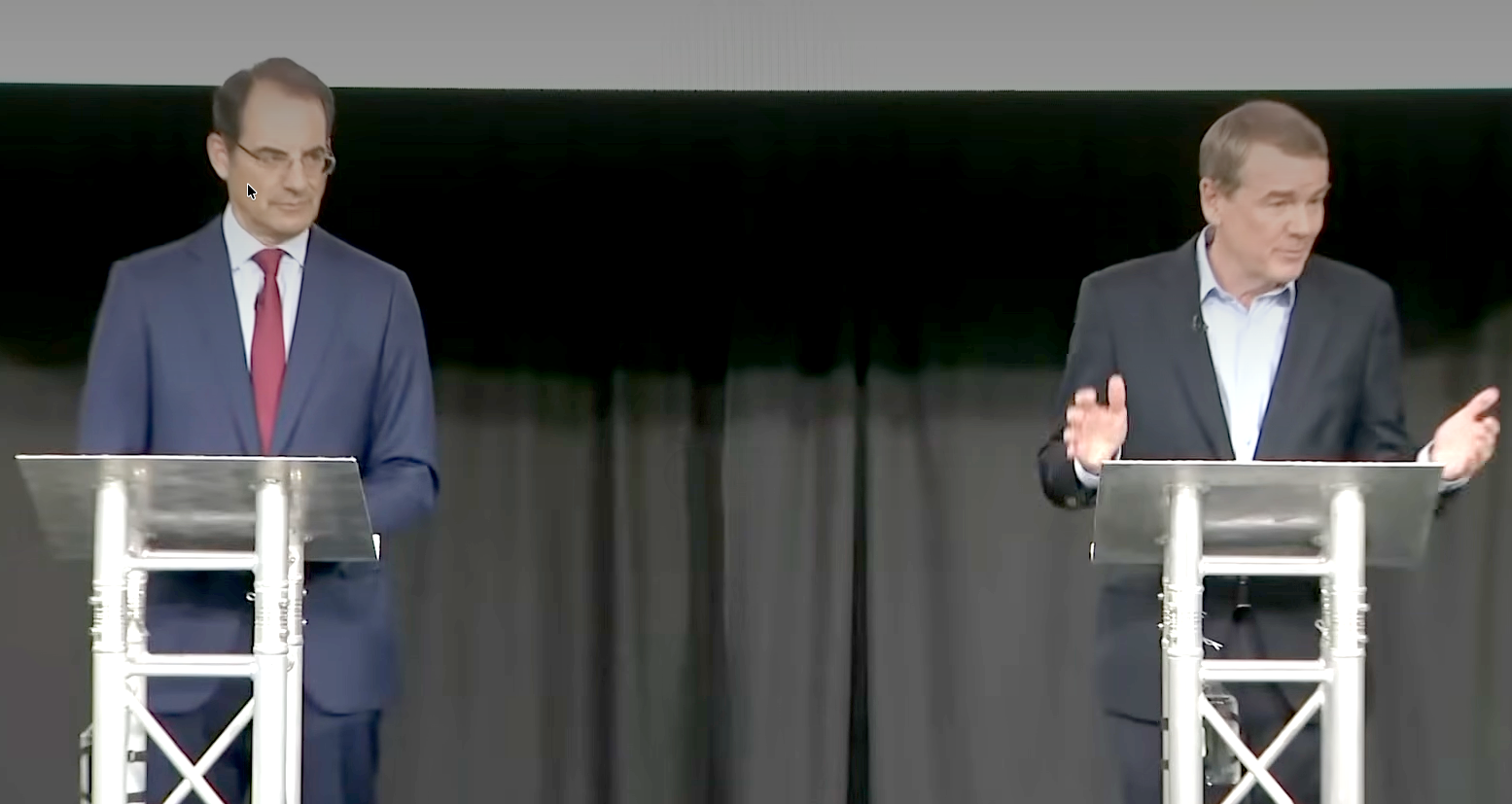
Bennet, Weiser spar in second Dem debate for governor, find common ground on many issues
DENVER | Colorado’s two Democratic candidates for governor, Sen. Michael Bennet and Attorney General Phil Weiser, traded barbs and underscored how they aligned on many policies during their second formal debate leading up to the June 30 Democratic primary election.
The hour-long debate, sponsored by 9News, The Denver Gazette, and Colorado Politics, came two days after the GOP gubernatorial debate held by the same group at the University of Denver.
Controversy started ahead of the debate when Bennet’s campaign launched a website alleging Weiser had engaged in “pay-to-play” schemes as attorney general. The website accuses Weiser of accepting large donations from lobbyists and corporate interests, including those with which his office was in active litigation, such as Comcast and TurboTax. In addition, the Bennet team criticized Weiser for attending an event with other state attorneys general, which was partially funded by companies they were suing or investigating.
A spokesperson for Weiser disputed the claims, saying that the website resurrects old, previously disproven partisan claims. Weiser argued that the three-term senator is deflecting from criticism that he has been too soft on the Trump administration as a member of the Senate.
For their part, the Weiser campaign launched its own set of websites detailing what it sees as misleading or false statements Bennet has made about Weiser’s record as Attorney General. In recent months, Bennet’s campaign ran attack ads against Weiser, claiming that Weiser failed to join key lawsuits against the Trump administration on a wide range of issues that include the environment, immigration, elections, and LGBTQ+ rights. However, Weiser filed his own of lawsuits or joined other state attorneys general on those very topics.
Also shadowing the debate was recent polling news showing that Weiser, once the underdog in the race with little name recognition has closed in on Bennet. Polling from Onsight shows that Weiser would receive 30% of the vote today and Bennet would receive 36%, showing a vast improvement for the Weiser campaign. The vast majority of potential voters in the primary race are undecided, the poll shows.
The debate
Over the course of the debate, both candidates were asked about their policy goals, housing, immigration, and their relationship with the Trump administration.
Although the campaign digs were touched on, Weiser emphasized his record of legal victories against the federal government while at the helm of Colorado’s justice department and Bennet returned to affordability.
Bennet and Weiser were first asked about their view on the declining popularity of the Democratic Party in the state. Polling indicates the Democratic Party is growing increasingly unpopular among Coloradans, even as they reject statewide GOP candidates.
Bennet said he found the Democratic losses to Trump in national levels discouraging, adding that he recognizes that voters have grown impatient with both major parties.
“People are really impatient with the parties,” Bennet said. “In fact, people my kids’ age hate the parties and don’t believe that they’re standing for them, and I think the Democratic Party and the Republican Party both have a lot of work to do.”
Bennet added that he believes that Colorado is still a purple state at its core, “and it needs a governor who’s going to govern the entire state, Republican or Democratic or unaffiliated.”
Weiser argued that the view many Coloradans have is that “the Democratic Party doesn’t show up, listen, and fight” for rural and working-class communities in particular; Weiser said he would remain committed to representing these communities as governor. Weiser pointed to his work holding town halls across the state on fighting the opioid crisis, visiting all 64 of Colorado’s counties, and his effort over the past two years to block the King Soopers-Safeway merger.
“If people know that you care about them, that you’re fighting for them, they can support you. If they think you don’t care and you don’t show up, they can’t,” Weiser said, also noting his endorsement from Eagle County Commissioner Matt Scherr.
Affordability
For voters across political parties, affordability remains a top issue in the state. With higher rents, property taxes, and homeowners’ insurance rates, Coloradans are increasingly finding it difficult to make ends meet.
Bennet argued that Colorado needed new leadership focused on affordability, calling the rising home prices and rents “unacceptable” and compared current housing costs to those in the 1990s when he and his wife bought a starter home in the state.
“When I used to be superintendent of schools, I had faculty meetings every day in schools like the one we’re in today, and I never met a teacher who didn’t live in Colorado or who didn’t live in Denver,” he said, remarking that for many the American dream was slipping away. “And now you can’t live in Denver if you’re a teacher, and if you live on the Western Slope… the only way a teacher can afford to live there is if they win the housing lottery that their school district is running. So until we address this issue of people working hard and not being able to have the American dream for their kids, I think we’re going to continue to see the rise of Trumpism in America, and that’s what we have to fight.”
If elected governor, Weiser said he would focus on creating incentives for the types of homes residents need to afford to live in their communities.
“If you build a mega mansion or a starter home, the permitting is the same. The time to get the permits is the same. We need to change that,” Weiser said. “We need to make sure we’re incentivizing town-homes, more density, condominiums, and we need to make sure we have down payment assistance, so those teachers and those firefighters, nurses can afford to buy those homes.”
Weiser also pointed to his record of bringing people together to work on these solutions between the legislature and local governments.
Weiser’s Use of Lawsuits
Weiser has filed 65 lawsuits against the Trump administration and that has been one of his primary tools as Colorado’s attorney general, but he would have to shift his focus if elected governor. During the debate, Weiser said that his job went beyond filing lawsuits and that would continue to listen to and work with people in the community.
“When I took on the opioid crisis, I did take on big pharma, companies like Purdue Pharma, Johnson and Johnson, and more, and I brought back $900 million to Colorado,” Weiser said. “But I didn’t say my job is done. I worked with people like Raquel Garcia, Raquel is an advocate in peer support, and I listened.”
Weiser said he worked with Garcia, a social worker and peer counselor in the Colorado Springs area, to build more peer counseling for those in recovery across the state of leading by listening.
“I’ve shown leadership by listening and by getting things done,” Weiser concluded.
Relationship to the Trump administration
Both Bennet and Weiser took swipes at each other’s response to the Trump administration, which has put Colorado in the crosshairs. Only seven other Senate Democrats voted to confirm more of Trump’s cabinet picks than Bennet, including controversial picks like U.S. Secretary of Agriculture Brook Rollins, U.S. Secretary of Interior Doug Burgrum, U.S. Secretary of Energy Chris Wright.
Bennet defended his votes for these cabinet members, arguing that “you have to work with people you profoundly disagree with.”
“The easiest vote in America is to vote against one of Donald Trump’s nominees, but when it’s the right thing to do for Colorado, when it’s the right thing to have the resources we need and the attention we need, I’ve done that,” Bennet said, arguing that he’s worked across the aisle to bring resources to Colorado to fight wildfires across the state.
In particular, Weiser criticized Bennet’s support for Trump’s cabinet nominees and that the senator should apologize for voting to confirm figures like U.S. Secretary of Agriculture Brooke Rollins who has sought to roll back SNAP benefits in Colorado.
“I believe that when someone is breaking the law and harming you, as Brooke Rollins has done a number of times, you don’t say I still support you,” Weiser said. “You say shame on you. I’m sorry I voted for you because you’re hurting us.”
Weiser added that when Rollins tried to roll back SNAP benefits from roughly 600,000 Coloradans, his department sued and won twice.
Bennet went after Weiser, arguing that the attorney general hadn’t joined enough lawsuits against the Trump administration, filing them only as he sought the governor’s office. He criticized Weiser for not being a part of a lawsuit during Trump’s first term over the administration’s policy of family separation at the southern border.
“If this is a question of toughness or willingness to stand up against the Trump administration, I think [Weiser] failed that test when refused, unlike the other Democrats who did, to ride to the rescue of the children that were being marooned from their parents on the southern border of the United States,” Bennet said.
Further, Bennet alleged that Weiser joined 65 lawsuits against the Trump administration during his second term as a political stunt, which Weiser has denied.
“He’s making a charge,” Weiser retorted. “It’s a serious charge, calling me an opportunist, bringing lawsuits for political reasons, not to protect the people of Colorado. When I sue, every time I take it seriously and I ask two questions. Is the law being broken? And are Coloradans being harmed?”
Weiser’s campaign pointed out that Weiser had sued the Trump administration in its first term on immigration issues. Weiser did the first Trump administration over the attempt to add a citizenship question to the 2020 census and to defend the Deferred Action for Childhood Arrivals (DACA) Program.
Immigration
Both Weiser and Bennet oppose President Trump’s effort of mass deportation of immigrants.
Weiser sued a Mesa County sheriff’s deputy for helping ICE detain a college student in violation of state law. Although he could not rely on the same tactic as governor, Weiser said he would instead rely on tools that already exist, like the public health inspection authority, to ensure ICE detention facilities operate safely and that civil rights aren’t being infringed.
“In Colorado, we believe in treating immigrants under the law fairly and sensibly,” Weiser said. “I will stand for that principle as your next governor.”
Weiser also said he wanted to ensure law enforcement held to Colorado law regarding cooperation with ICE: “I want the community to know that when you call 911, you’re not jeopardizing your family’s safety. I also know that we don’t have enough law enforcement. We need our law enforcement doing law enforcement and this administration can’t bully us. If law enforcement violates the law, it’s my job to hold them to account.”
For his part, Bennet made a recent campaign promise to block ICE from opening new detention facilities in Colorado and advocated for expanding the local governments to deny permit requests for ICE detention centers.
Bennet referred to the issue as a “test.”
“It is a test of whether you’re willing to fight this fight, and whether you’re tough enough to fight this fight,” Bennet said. “I am not going to allow Donald Trump to send masked agents into Colorado or to allow him to have federal agents knocking on doors without warrants, and I’m certainly not going to allow him to separate kids at the border.”
Bennet additionally pointed to his willingness to stand up for immigrants when he was superintendent of Denver Public Schools and his work in 2013 advocating for students to have access to in-state tuition in the Senate.
Reflecting on Jared Polis’s tenure as Governor
The candidates were in lockstep when it came to evaluating Gov. Jared Polis’ tenure.
Both Bennet and Weiser agreed that the best thing Polis accomplished in office was implementing Colorado’s universal pre-kindergarten program.
Similarly, both argued the governor’s vetoes of bills regulating social media companies were ultimately bad for the state. Polis recently vetoed a bill that would have required social media companies to comply with search warrants within 24 hours.
Furthermore, both Bennet and Weiser were sharply critical of Polis’ decision to pardon Tina Peters, the former county clerk convicted of conspiracy to commit criminal impersonation and attempting to influence a public servant in an attempt to propel election conspiracy theories.
Labor Rights
Labor unions have been fighting to change Colorado’s Labor Peace Act, which makes it harder to collect union dues from all employees and collectively bargain. Polis twice vetoed a bill that would have abolished a required second vote for union security negotiation.
Weiser said he was committed to standing by unions and getting rid of the Labor Peace Act.
“I’m committed to getting rid of the antiquated Labor Peace Act, substituting it,” Weiser said, adding the bill may change in the legislature, but that it was going to “be the right thing for Colorado”.
Bennet, however, argued that there needed to be compromise between labor unions and business groups.
“My compromise would be to keep that second vote, but reduce the difficulty of being able to pass that second vote,” Bennet said. “I don’t think it’s helped very much that the governor has said that he would veto the bill in advance.”
Bennet said he believed Polis’ public stance on the bill had taken leverage away from negotiations.
Polis rapid fire vetoes
Polis has vetoed 12 bills so far this year, a recorder for the term-limited governor. Debate moderates asked each candidate where they stood on several bills the governor shot down.
On a bill that would have allowed people to sue federal officers in state court if their civil rights were violated during immigration enforcement operations, both candidates said they would have signed it.
Both candidates said they would have signed a bill requiring major social media platforms to comply with law enforcement warrants within 24 hours.
On a bill that would have banned landlords from using algorithmic software to set rent prices, which consumer advocates argue allows for landlords to drive up rent prices, both candidates said they would have signed it. Weiser added he had an ongoing lawsuit on the same issue.
“Colorado and the American West is going through a wildfire crisis,” One of the easiest thing to do is to vote against of one of Trump’s nominees,”
“I believe when someone is breaking the law and harming you, like Brooke Rollins has done several times, you don’t say ‘I still support you.”
More on Bennet’s attack ads
Bennet has launched a series of attack ads against Phil Weiser, including those on his website, attacking Weiser as “pay-to-play” Phil. The accusations originated from the Public Trust Institute, a dark-money nonprofit that has ties to a conservative advocacy group that backed Weiser’s Republican opponent in 2022.
Bennet defended the attack saying that “not only did he not sue Donald Trump with respect to kids at the border, he took a pass on some of the most important environmental lawsuits that were bought in this nation…”
Weiser responded by saying that Bennet’s accusations were “politics at its cynical worst.”
“I am saddened by these desperate, baseless claims,” Weiser said. “This was a right-wing dark-money attack on me. It was debunked, and after it was out there, Sen. Bennet was campaigning with me, praising me to be attorney general. And now he is basically trying to recycle those discredited attacks.”
Weiser again pointed to his record of suing to break up major corporations like Live Nation, stop the Kroger/Albertsons merger, and going after exploitative tech companies.
Weiser criticized Bennet for accepting large financial donations from out-of-state interests.
Weiser further said committed to “change Citizens United here in Colorado and get corporate dark-money out of politics.”
Bennet has the backing of a super PAC called Rocky Mountain Way which has given him a substantial funding advantage; it has collected over $8 million in donations from wealthy donors, including $2.6 million from Michael Bloo, a billionaire and former mayor of New York City. Other major donors to Rocky Mountain Way include: Uber, Conscience Bay Research of New York, the Colorado League of Charter Schools, and a variety of developers.
The race to June 30
Although the primary race has become more combative, the two candidates continue to present similar policies as to what they would pursue as the state’s chief executive.
Both Weiser and Bennet promised to expand access to affordable housing and starter homes, block the Trump administration’s mass deportation agenda, and protect Colorado’s water rights heading into what is shaping up to be one of the driest years on record.
You can watch the full debate on 9News.
Ballots will be mailed out in Colorado to all active registered voters beginning on June 8. Election Day is June 30. For full primary election coverage, seek out the Sentinel Colorado voter guide, online and in print next week.
Read more Movie Review: ‘Scary Movie 6’ brings back the Wayans and the Core Four for a rapid-fire horror spoof
Read more Shia LaBeouf gets probation after pleading guilty to punching bargoers during Mardi Gras
Read more Kennedy Center moves to erase Trump references after judge said they were illegally added
