Aurora City Council to review proposed decorum changes for public speakers
AURORA | In an effort to calm the occasionally raucous city council meetings, Aurora’s elected officials will consider changes to the city’s decorum rules, including a protocol for public speakers who surpass the time limit.
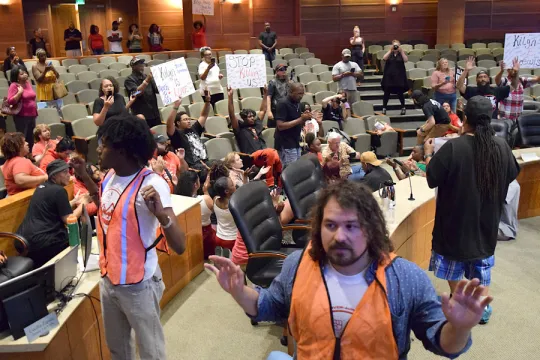
City council meetings have a recent history of regular combativeness among council members and between public commenters and council members.
Heated meetings peaked in 2024 and 2025 after police shot and killed Kilyn Lewis while he was being arrested in Aurora, culminating with a meeting where council members fled the council chambers because of raucous protesters. Council meetings were temporarily held virtually to avoid conflict, though they have returned to in-person.
On June 8, the city council will review the proposed decorum changes during its study session. The proposed changes come from the City Council Rules Committee, which has been discussing the public comment process since March. The committee presented its changes at a May 26 meeting.
Due to First Amendment protections, the council is limited in how it can regulate public comment and can’t prohibit certain kinds of speech, like profanity or name calling, according to City Attorney Pete Schulte.
Instead, the decorum changes focus on encouraging council members to act as role models for respectful dialogue and requesting commenters follow suit. In an effort to set the tone, the city attorney would read the decorum rules ahead of the public comment period.
The biggest change would be implementing consequences for speakers who go over the city’s three minute comment limit.
Under the proposed rules, if a speaker goes over their allotted time, the mayor will ask the speaker to wrap up and allow them a 10 second grace period. If the speaker continues past the grace period, the mayor will issue a final warning and if the speaker ignores the final warning then the mayor can ban the speaker from public comment at the next meeting. The ban would only last for one meeting and would not apply to public hearing items.
Some speakers at the May meeting pushed back against the plan, questioning whether it’s right for the council to cut speakers off, especially those who may be grieving or emotional.
“I just don’t know what it looks like to tell a grieving mother or a grieving child or a grieving father, you’ve got three minutes and that’s all we’ll give you,” activist Midian Shofner said. Shofner regularly speaks about the Kilyn Lewis issue. “I don’t even know how to fathom what it looks like for a grieving parent to get a piece of paper that says you cannot come back next time because you went over this rule that we have.”
The only proposed rule regarding the content of speech is that comments should be directed at city council and not audience members.
No changes have yet been proposed for the city’s disruption protocol, which allows meetings to be held virtually if there’s a disturbance. However, Councilmember Alison Coombs said potential changes may still be identified.
To help de-escalate disruptive behavior, local activist Auon’tai Anderson suggested the city should identify a qualified and trained staff member to act as a third-party mediator and step in if conflict arises among audience members during the meeting.
The committee also proposed changes to the order of the meeting and dedicating a public comment period for youth.
The proposed decorum and meeting changes include:
- Dedicating a 30 minute initial public comment period for youth 18 and younger, in addition to the one hour initial public comment period for all ages
- Reducing the second public comment period at the end of the meeting to 30 minutes for people who haven’t spoken yet
- Moving council reports up to the beginning of the meeting before public comment and limiting them to three minutes
- Removing the restriction on only one person being allowed at the podium during public comments
- Public speakers are required to address their comments to the council, not other members of the public
- Speakers are requested, not required, to give their legal name and whether they’re a resident
The committee is also recommending that the city work on allowing public commenters to speak virtually if they make an accommodation request.
In addition to the decorum rules for public commenters, the committee suggested more penalties for council members who don’t follow decorum. The rules currently only allow the council to enact a censure resolution against a member who violates the rules.
Proposed sanctions include the loss of the member’s travel and training budget, removal from committee chair positions, exclusion from executive sessions and a public reprimand, which would be a formal document and could require the council member to receive training or education.
Read more Trump names real estate scion Bill Pulte acting intelligence director alarming GOP and Dems
Read more Aurora Councilmember Rob Andrews pleads guilty to DUI charge, gets 10-days home detention
Read more Trump administration is scrapping $1.8B fund meant to compensate president’s allies, Blanche says
